Schutzhund Dogs

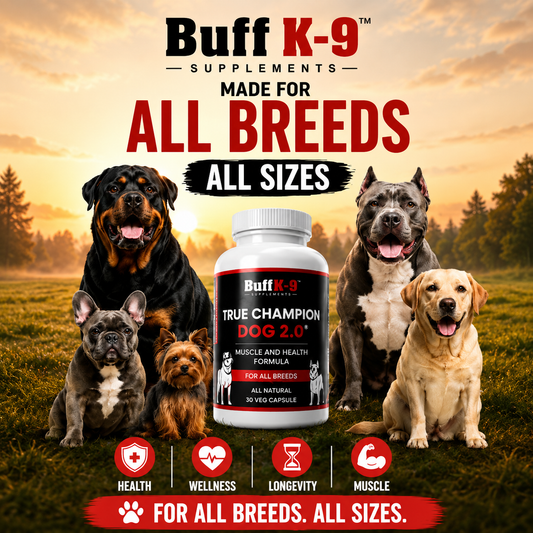
Schutzhund dogs are under intense exercise routines. On a constant proving ground, these dogs are put through several tests and training procedures which tear down muscle fiber and strain joints on our dogs. The proper trainer should know the benefits that ALL NATURAL Buff K-9 Dog Vitamin Supplements offer for extreme performance dogs as well as everyday pets.

As schutzhund enthusiasts, we know that after a training session our dogs are fatigued and sore the next day. You can tell by the movements of your dog being slightly slower, the same way humans get sore after an intense workout. Our movements become a bit delayed until the lactic acid clears out of our muscles and we can move more freely, same goes for your dog.

Buff K-9 Supplements produces only all natural vitamins which are strong enough to boost performance for working and show dogs, and gentle enough to support overall health for everyday pets.

Having the right nutrients through proper supplementation means having a dog who is thoroughly nourished and ready to work. Please pay attention to your dog’s needs, dog food by itself will not cut it for these athletic dogs.

Buff K-9 Endurance & Stamina Booster features the following benefits:

  • Significantly enhances endurance & stamina
  • Protect the Heart Muscle
  • Improve Blood Flow and oxygen saturation
  • Nitric oxide production

Click here to learn more about the Endurance & Stamina Booster

Buff K-9 Original (black label) features the following benefits for schutzhund dogs along with all types of dogs:

  • Lean muscle building/ weight gain
  • Performance/ recovery
  • Health/ wellness
  • Joints
  • Skin & Coat

Click here to learn more about Buff K-9 Original

Hunting Dogs

Hunting dogs do a lot of hard work. If you take your dog hunting or retrieving, make sure to replenish their muscles and overall bodies with ALL NATURAL Buff K-9 Dog Vitamin Supplements.  Ensuring your dog is in top condition can make the difference between mediocre performance or top dog performance.

Having the right nutrients through proper supplementation means having a dog who is thoroughly nourished and ready to work. Don’t ignore the symptoms of a dog that is fatigued and sore from a long day hunting/ exercising. These performance dogs need more than what dog food alone can provide them.

Buff K-9 Endurance & Stamina Booster features the following benefits:

  • Significantly enhances endurance & stamina
  • Protect the Heart Muscle
  • Improve Blood Flow and oxygen saturation
  • Nitric oxide production

Click here to learn more about the Endurance & Stamina Booster

Buff K-9 Original (black label) features the following benefits for hunting dogs along with all types of dogs:

  • Lean muscle building/ weight gain
  • Performance/ recovery
  • Health/ wellness
  • Joints
  • Skin & Coat

Click here to learn more about Buff K-9 Original

Great Dane Information

Great Dane

Great Dane information hosted by dog vitamin supplement provider Buff K-9 Supplements.

>“The Great Dane (18th Cent. French: Grand Danois), also known as German Mastiff (German: Deutsche Dogge) or Danish Hound (German: Dänischer Hund), is a breed of domestic dog (Canis lupus familiaris) known for its giant size” (“Great Dane”).

> “From year to year, the tallest living dog is typically a Great Dane” (“Great Dane”).

> “Great Danes have naturally floppy, triangular ears. In the past, when Great Danes were commonly used to hunt boars, cropping of the ears was performed to make injuries to the dogs’ ears less likely during hunts. Now that Danes are primarily companion animals, cropping is sometimes still done for traditional and cosmetic reasons” (“Great Dane”).

> “The Great Dane’s large and imposing appearance belies its friendly nature; the breed is often referred to as a gentle giant” (“Great Dane”).

> “Great Danes, like most giant dogs, have a fairly slow metabolism. This results in less energy and less food consumption per pound of dog than in small breeds. Great Danes have some health problems that are common to large breeds, including gastric dilatation-volvulus (GDV) (a painful distending and twisting of the stomach). This is a critical condition that can affect Great Danes and other deep-chested breeds, and which may cause death if not quickly addressed. Drinking large amounts of fluid in a short period of time can provoke GDV in Great Danes, as well as other larger breeds of dogs” (“Great Dane”).

>”Dilated cardiomyopathy (DCM) and many congenital heart diseases are also commonly found in the Great Dane, leading to its nickname: the Heartbreak breed, in conjunction with its shorter lifespan” (“Great Dane”).

Resources

“Great Dane.” Wikipedia, The Free Encyclopedia. Wiimedia Foundation, Inc.. 21 May 2012. Web. 23 May 2012. <http://en.wikipedia.org/wiki/Great_Dane#cite_note-AKC-3 >.

Becker, The Great Dane – Embodying a Full Exposition of the History, Breeding Principles, Education, and Present State of the Breed (a Vintage Dog Books Breed Classic): Embodying a Full Exposition the History, Breeding Principles, Education, and Present State of the Breed, Published by READ BOOKS, 2005, ISBN 1-905124-43-0.

“Great Dane Breed Standard”. American Kennel Club. 1999.

Husky Information

Husky

Husky information hosted by dog vitamin supplement provider Buff K-9 Supplements.

>“ Husky is a general name for a type of dog used to pull sleds in northern regions, differentiated from other sled dog types by their fast pulling style” (“Husky”).

> “Husky type dogs are energetic and athletic. They usually have a thick double coat. Huskies   are known for pale blue eyes, although they may also have brown eyes” (“Husky”).

> “Huskies are used in sled dog racing” (“Husky”).

> “Huskies are more commonly affected with some degree of uveitis than other types of dogs” (“Husky”).

Resources

“Husky.” Wikipedia, The Free Encyclopedia. Wiimedia Foundation, Inc.. 21 May 2012. Web. 18 May 2012. <http://en.wikipedia.org/wiki/Husky#cite_note-6 >.

Dogs of the Iditarod, by Jeff Schultz, pg 41, Sasquatch Books, January 28, 2003, ISBN 1-57061-292-7

The Oxford Pocket Dictionary of Current English 2009 online http://www.encyclopedia.com/topic/husky.aspx

Dogue de Bordeaux Information

Dogue de Bordeaux

Dogue de Bordeaux information hosted by dog vitamin supplement provider Buff K-9 Supplements.

> “Bordeaux are very powerful dogs, with a very muscular body yet retaining a harmonious temperament. The breed has been utilized in many different forms, from using their brawn to pull carts or haul heavy objects, to guarding flocks and used to protect castles of the European elite” (“Dogue de Bordeaux”).

> “Dogue de Bordeaux, also called French Mastiff or Bordeaux Bulldog, is longer in body than it is tall, and is a well muscled and stocky Molosser breed with a heavy, broad head, and deep chest, not appearing “leggy” in any way” (“Dogue de Bordeaux”).

> “The breed standards by European FCI and the American Kennel Club specify a minimum weight of 100 lbs for a female and 115 lbs for a male” (“Dogue de Bordeaux”).

> “The massive head is a crucial breed characteristic. The Dogue de Bordeaux is claimed to have the largest head in the canine world, in proportion to the rest of the body” (“Dogue de Bordeaux”).

Resources

“Dogue de Bordeaux.” Wikipedia, The Free Encyclopedia. Wiimedia Foundation, Inc.. 21 May 2012. Web. 18 May 2012. <http://en.wikipedia.org/wiki/Dogue_de_Bordeaux#cite_note-1 >.

Review AKC breed standard for verification: http://www.akc.org/breeds/dogue_de_bordeaux/

Keywords

Greyhound Information

Greyhound

Greyhound information hosted by dog vitamin supplement provider Buff K-9 Supplements. Please check out Buff K-9′s top rated Endurance & Stamina Booster. www.buffk-9.com

> “The Greyhound is a breed of sighthound that has been primarily bred for coursing game and racing, and the breed has also recently seen a resurgence in its popularity as a pedigree show dog and family pet. It is a gentle and intelligent breed” (“Greyhound”).

> “A combination of long, powerful legs, deep chest, flexible spine, and slim build allows it to reach average race speeds in excess of 18 metres per second (59 feet per second) or 63 kilometres per hour (39 mph)” (“Greyhound”).

> “Males are usually 71 to 76 centimetres (28 to 30 in) tall at the withers and weigh around 27 to 40 kilograms (60 to 88 lb). Females tend to be smaller with shoulder heights ranging from 68 to 71 centimetres (27 to 28 in) and weights from less than 27 to 34 kilograms (60 to 75 lb)” (“Greyhound”).

> “Aside from professional racing, many Greyhounds enjoy success on the amateur race track. Organizations like the Large Gazehound Racing Association (LGRA) and the National Oval Track Racing Association (NOTRA) provide opportunities for Greyhounds and other sighthound breeds to compete in amateur racing events all over the United States” (“Greyhound”).

> “Greyhounds are typically a healthy and long-lived breed, and hereditary illness is rare. Some Greyhounds have been known to develop esophageal achalasia, bloat (gastric torsion), and osteosarcoma” (“Greyhound”).

Resources

“Greyhound.” Wikipedia, The Free Encyclopedia. Wiimedia Foundation, Inc.. 21 May 2012. Web. 18 May 2012. <http://en.wikipedia.org/wiki/Greyhound#Cultural_references_to_greyhounds >.

Gunnar von Boehn. “Shepparton (VIC) Track Records”. Greyhound-data.com. Retrieved 2011-05-31.

Gunnar von Boehn. “Singleton (NSW) Track Records”. Greyhound-data.com. Retrieved 2011-05-31.

Gunnar von Boehn. “Capalaba (QLD) Track Records”. Greyhound-data.com. Retrieved 2011-05-31.

“Large Gazehound Racing Association”. Lgra.org. Retrieved 2011-05-31.

“National Oval Track Racing Association”. Notra.org. Retrieved 2011-05-31.

Belgian Shepherd Dog (Malinois) Information

Belgian Shepherd Dog (Malinois)

Belgian Shepherd Dog (Malinois) information hosted by dog vitamin supplement provider Buff K-9 Supplements.

> “Like all Belgian Shepherds, the Malinois is a medium-sized and square-proportioned dog in the sheepdog family. The Malinois has a short mahogany coat with black markings. It has black erect ears and a black muzzle. It has a square build in comparison to the German Shepherd” (“Belgian Shepherd Dog”).

> “In Belgium, Germany, the Netherlands and other European countries, as well as in the United States, Canada and Australia, the Malinois is bred primarily as a working dog for personal protection, detection, police work, search and rescue, and sport work” (“Belgian Shepherd Dog”).

> “They can be destructive or develop neurotic behaviors if not provided enough stimulation and exercise. These are medium sized, strong dogs that require consistent obedience training, and enjoy being challenged with new tasks” (“Belgian Shepherd Dog”).

> “Malinois can compete in dog agility trials, obedience, showmanship, flyball, tracking, and herding events, and are one of the most popular breeds used in protection sports such as schutzhund, French Ring, and Mondio Ring” (“Belgian Shepherd Dog”).

> “Notable health problems prevalent to the Malinois includes cataracts, epilepsy, thyroid disease, progressive retinal atrophy (PRA), hip dysplasia, and pannus, although these problems have been minimized through selective breeding” (“Belgian Shepherd Dog”).

Resources

“Belgian Shepherd Dog.” Wikipedia, The Free Encyclopedia. Wiimedia Foundation, Inc.. 21 May 2012. Web. 18 May 2012. < http://en.wikipedia.org/wiki/Belgian_Shepherd_Dog_%28Malinois%29>.

“Frequently Asked Questions”. Belgian Shepherd Dog Club of Canada. Retrieved 2011-05-07.

Frequently Asked Questions”. MalinoisClub.com. Retrieved 2011-05-07.

“About Belgian Shepherd Dogs”. Northern Belgian Shepherd Dog Club. 2004-01-01. Retrieved 2011-05-07.

Frequently Asked Questions”. MalinoisClub.com. Retrieved 2011-05-07.

“About Belgian Shepherd Dogs”. Northern Belgian Shepherd Dog Club. 2004-01-01. Retrieved 2011-05-07.

German Shepherd Information

German Shepherd

German Shepherd information hosted by dog vitamin supplement provider Buff K-9 Supplements.

> “As part of the Herding Group, the German Shepherd is a working dog developed originally for herding and guarding sheep. Because of its strength, intelligence and abilities in obedience training it is often employed in police and military roles around the world” (“German Shepherds”).

> “German Shepherds are a large sized dog which generally are between 55 and 65 centimetres (22 and 26 in) at the withers and weigh between 22 and 40 kilograms (49 and 88 lb)” (“German Shepherds”).

> “They have a domed forehead, a long square-cut muzzle and a black nose. The jaws are strong, with a scissor-like bite” ” (“German Shepherds”).

> “The breed is marked by a willingness to learn and an eagerness to have a purpose. They are curious which makes them excellent guard dogs and suitable for search missions” ” (“German Shepherds”).

> Common health issues of German Shepherd’s are: hip and elbow dysplasia, arthritis, and ear infections” (“German Shepherds”).

> “German Shepherds are a very popular selection for use as working dogs. They are especially well known for their police work, being used for tracking criminals, patrolling troubled areas, and detection and holding of suspects. Additionally thousands of German Shepherds have been used by the military” ” (“German Shepherds”).

Resources

“German Shepherds.” Wikipedia, The Free Encyclopedia. Wiimedia Foundation, Inc.. 21 May 2012. Web. 18 May 2012. < http://en.wikipedia.org/wiki/German_Shepherd#cite_note-german-culture-1>.

“German Shepherd — The Ultimate Service Dog”. German Culture. Retrieved 15 July 2008.

Golden Retriever Information

Golden Retriever

Golden Retriever information hosted by dog vitamin supplement provider Buff K-9 Supplements.

>  “The Golden retriever’s intelligence gives them the ability to be versatile and play a variety of roles including guide dog for the blind, hearing dog for deaf people, hunting dog, illegal drug detector, and search and rescue participant” (“Golden Retriever”).

> “Golden Retrievers are exceptionally trainable—due to their intelligence, athleticism and desire to please their handlers—and generally excel in obedience trials. They are also very competitive in agility and other performance events” (“Golden Retriever”).

> Common diseases that Golden Retriever’s may face are:  cancer, obesity, hip and elbow dysplasia, heart disease, joint disease, and skin disease (“Golden Retriever”).

> “The Golden Retriever’s eagerness to please has made them consistent, top performers in the obedience and agility rings. Furthermore, their excellent swimming ability allowed them to be considered great at dock jumping. Their natural retrieving ability also sees them excel in flyball and field trials” (“Golden Retriever”).

Resources

“Golden Retriever.” Wikipedia, The Free Encyclopedia. Wiimedia Foundation, Inc.. 21 May 2012. Web. 18 May 2012. < http://en.wikipedia.org/wiki/Golden_Retriever#cite_note-Golden_Retrievers:_History-8>.

Golden Retrievers: History. K9web.com. Retrieved on November 30, 2007.

Rottweiler Information

Rottweiler

Rottweiler information hosted by dog vitamin supplement provider Buff K-9 Supplements.

> “Rottweiler breeders aim at a dog of abundant strength, black coated with clearly defined rich tan markings, whose powerful appearance does not lack nobility and which is exceptionally well suited to being a companion, service and working dog” ( FCI Standard N° 147 Op. Citi.).

> “A Rottweiler is self-confident and responds quietly and with a wait-and-see attitude to influences in its environment. It has an inherent desire to protect home and family, and is an intelligent dog of extreme hardness and adaptability with a strong willingness to work, making them especially suited as a companion, guardian and general all-purpose dog”(“Rottweiler”).

> One health issue that Rottweiler’s may face is hip dysplasia.

> “For unknown reasons, Rottweilers are more susceptible than other breeds to become infected with parvovirus, a highly contagious and deadly disease of puppies and young dogs” (“Rottweiler”).

> “If overfed or under exercised, Rottweilers are prone to obesity. Some of the consequences of obesity can be very serious, including arthritis, breathing difficulties, diabetes, heart failure, reproductive problems, skin disease, reduced resistance to disease and overheating caused by the thick jacket of fat under the skin” (“Rottweiler”).

Resources

Fédération CynoIogique Internationale-Standard N° 147/ 19. 06. 2000 / GB The Rottweiler. Translated by – Mrs C. Seidler Country of Origin – Germany. Available online at ADRK website Rottweiler Breed Standard, ADRK.de

Les Price, Rottweilers: An Owner’s Companion. New York: Macmillan,1991, p. 114.

“Rottweiler.” Wikipedia, The Free Encyclopedia. Wiimedia Foundation, Inc.. 20 May 2012. Web. 18 May 2012. < http://en.wikipedia.org/wiki/Rottweiler#cite_note-7>.

© 2013 - BuffK-9™ Supplements, All Rights Reserved
Wordpress Themes